Friday, December 10, 2010

Tea'd Off | Politics | Vanity Fair

Tea’d Off
Forfeiting a both-houses Republican victory, rational conservatives ignored or excused the most hateful kind of populist claptrap (e.g., the fetid weirdness of Glenn Beck’s 9/12 Project). The poison they’ve helped disseminate will still be in the American bloodstream when the country needs it least.
By Christopher Hitchens•
Illustration by Ross MacDonald
January 2011

PATRIOT GAMES
The author says of a Tea Party rally, ”I don’t remember ever seeing grown-ups behave less seriously.”

It is often in the excuses and in the apologies that one finds the real offense. Looking back on the domestic political “surge” which the populist right has been celebrating since last month, I found myself most dispirited by the manner in which the more sophisticated conservatives attempted to conjure the nasty bits away.

Here, for example, was Ross Douthat, the voice of moderate conservatism on the New York Times op-ed page. He was replying to a number of critics who had pointed out that Glenn Beck, in his rallies and broadcasts, had been channeling the forgotten voice of the John Birch Society, megaphone of Strangelovian paranoia from the 1950s and 1960s. His soothing message:

These parallels are real. But there’s a crucial difference. The Birchers only had a crackpot message; they never had a mainstream one. The Tea Party marries fringe concerns (repeal the 17th Amendment!) to a timely, responsible-seeming message about spending and deficits.

The more one looks at this, the more wrong it becomes (as does that giveaway phrase “responsible-seeming”). The John Birch Society possessed such a mainstream message—the existence of a Communist world system with tentacles in the United States—that it had a potent influence over whole sections of the Republican Party. It managed this even after its leader and founder, Robert Welch, had denounced President Dwight D. Eisenhower as a “dedicated, conscious agent” of that same Communist apparatus. Right up to the defeat of Barry Goldwater in 1964, and despite the efforts of such conservatives as William F. Buckley Jr. to dislodge them, the Birchers were a feature of conservative politics well beyond the crackpot fringe.
Christopher Hitchens

Now, here is the difference. Glenn Beck has not even been encouraging his audiences to reread Robert Welch. No, he has been inciting them to read the work of W. Cleon Skousen, a man more insane and nasty than Welch and a figure so extreme that ultimately even the Birch-supporting leadership of the Mormon Church had to distance itself from him. It’s from Skousen’s demented screed The Five Thousand Year Leap (to a new edition of which Beck wrote a foreword, and which he shoved to the position of No. 1 on Amazon) that he takes all his fantasies about a divinely written Constitution, a conspiratorial secret government, and a future apocalypse. To give you a further idea of the man: Skousen’s posthumously published book on the “end times” and the coming day of rapture was charmingly called The Cleansing of America. A book of his with a less repulsive title, The Making of America, turned out to justify slavery and to refer to slave children as “pickaninnies.” And, writing at a time when the Mormon Church was under attack for denying full membership to black people, Skousen defended it from what he described as this “Communist” assault.

So, Beck’s “9/12 Project” is canalizing old racist and clerical toxic-waste material that a healthy society had mostly flushed out of its system more than a generation ago, and injecting it right back in again. Things that had hidden under stones are being dug up and re-released. And why? So as to teach us anew about the dangers of “spending and deficits”? It’s enough to make a cat laugh. No, a whole new audience has been created, including many impressionable young people, for ideas that are viciously anti-democratic and ahistorical. The full effect of this will be felt farther down the road, where we will need it even less.

I remember encountering this same mentality a few years ago, when it was more laughable than dangerous. I didn’t like Bill Clinton: thought he had sold access to the Lincoln Bedroom and lied under oath about sexual harassment and possibly even bombed Sudan on a “wag the dog” basis. But when I sometimes agreed to go on the radio stations of the paranoid right, it was only to be told that this was all irrelevant. Didn’t I understand that Clinton and his wife had murdered Vince Foster and were, even as I spoke, preparing to take advantage of the Y2K millennium crisis—remember that?—in order to seize power for life and become the Nicolae and Elena Ceauşescu of our day? These people were not interested in the president’s actual transgressions. They were looking to populate their fantasy world with new and more lurid characters.

There is an old Republican saying that “a government strong enough to give you everything you want is strong enough to take away everything you have.” This statement contains an essential truth that liberals have no right to overlook. But it is negated, not amplified, if it comes festooned with racism and superstition. In the recent past, government-sponsored policies of social engineering have led to surprising success in reducing the welfare rolls and the crime figures. This came partly from the adoption by many Democrats of policies that had once been called Republican. But not a word about that from Beck and his followers, because it isn’t exciting and doesn’t present any opportunity for rabble-rousing. Far sexier to say that health care—actually another product of bipartisanship—is a step toward Nineteen Eighty-Four. Ten percent unemployment, on the other hand, is rather a disgrace to a midterm Democratic administration. But does anybody believe that unemployment would have gone down if the hated bailout had not occurred and GM had been permitted to go bankrupt? Why not avoid the question altogether and mutter about a secret plan to proclaim a socialist (or Nazi, or Jew-controlled: take your pick) dictatorship?

Again, there is a real debate about the pace and rhythm of global warming, and about the degree to which it has been caused (or can be slowed) by human activity. But at the first Tea Party rally I attended, at the Washington Monument earlier this year, the crowd—bristling with placards about the Second Amendment’s being the correction—was treated to an arm-waving speech by a caricature English peer named Lord Monckton, who led them in the edifying call-and-response: “All together. Global warming is?” “Bullshit.” “Obama cannot hear you. Global warming is?” “bullshit.” “That’s bettah.” I don’t remember ever seeing grown-ups behave less seriously, at least in an election season.

Most epochs are defined by one or another anxiety. More important, though, is the form which that anxiety takes. Millions of Americans are currently worried about two things that are, in their minds, emotionally related. The first of these is the prospect that white people will no longer be the majority in this country, and the second is that the United States will be just one among many world powers. This is by no means purely a “racial” matter. (In my experience, black Americans are quite concerned that “Hispanic” immigration will relegate them, too.) Having an honest and open discussion about all this is not just a high priority. It’s more like a matter of social and political survival. But the Beck-Skousen faction want to make such a debate impossible. They need and want to sublimate the anxiety into hysteria and paranoia. The president is a Kenyan. The president is a secret Muslim. The president (why not?—after all, every little bit helps) is the unacknowledged love child of Malcolm X. And this is their response to the election of an extremely moderate half-African American candidate, who speaks better English than most and who has a model family. Revolted by this development, huge numbers of white people choose to demonstrate their independence and superiority by putting themselves eagerly at the disposal of a tear-stained semi-literate shock jock, and by repeating his list of lies and defamations. But, of course, there’s nothing racial in their attitude …

As I started by saying, the people who really curl my lip are the ones who willingly accept such supporters for the sake of a Republican victory, and then try to write them off as not all that important, or not all that extreme, or not all that insane in wanting to repeal several amendments to a Constitution that they also think is unalterable because it’s divine! It may be true that the Tea Party’s role in November’s vote was less than some people feared, and it’s certainly true that several of the movement’s elected representatives will very soon learn the arts of compromise and the pork barrel. But then what happens at the next downturn? A large, volatile constituency has been created that believes darkly in betrayal and conspiracy. A mass “literature” has been disseminated, to push the mad ideas of exploded crackpots and bigots. It would be no surprise if those who now adore Beck and his acolytes were to call them sellouts and traitors a few years from now. But, alas, they would not be the only victims of the poisonous propaganda that’s been uncorked. Some of the gun brandishing next time might be for real. There was no need for this offense to come, but woe all the same to those by whom it came, and woe above all to those who whitewashed and rationalized it.

Obama's tax-cut deal: Some major Democratic donors plan to withhold funds

Obama's tax-cut deal upsets many major donors

Some say they will withhold funds for the next election. Even if they come around before the campaign kicks into gear, the initial backlash could hurt early Democratic efforts to counter GOP-allied groups.

By Matea Gold, Tribune Washington Bureau

December 9, 2010, 4:39 p.m.

la-na-dem-donors-20101210

Reporting from Washington —
President Obama's advisors are confident that liberals dismayed by his agreement to extend tax breaks for the wealthy will forgive him by the time the 2012 election kicks into gear.

But the current backlash on the left may intensify the immediate challenge Democrats face in building a new campaign finance apparatus to challenge Republican-allied outside groups that flexed their muscles in this year's midterm election.

Democratic operatives are already laying plans to set up new independent expenditure committees that can raise unlimited funds, and hope to enroll early contributors to establish a beachhead for the coming campaign. But some stalwart party donors are vowing to withhold funds because of their anger over the tax-cut deal.

"I do not plan to support Obama and his reelection effort," said Utah-based hedge fund manager Art Lipson, who gave hundreds of thousands of dollars to the Democratic Party and its allies in recent elections. He views the tax-cut compromise as a giveaway to Republicans that will increase the deficit.

"He's got many great qualities, but he is not a fighter," Lipson said of the president. "I've met with many donors and the level of disappointment is extreme."

Other discontented contributors are taking a wait-and-see approach.

"I would say I'm not a happy camper," said Paul Egerman, a software entrepreneur in Boston, who said this was the first time he felt Obama reversed himself on a significant policy issue. "That troubles me. I need to be convinced he really had no alternative."

The discontent in the party was underscored Thursday when House Democrats rejected the tax-cut plan in a rowdy closed-door caucus, raising questions about the measure's chances of passing.

Democratic officials said they were confident that both Obama and the party would have plenty of money in 2012, noting that the Democratic National Committee raised a record $195 million in this cycle despite anger in the liberal wing about the lack of a public option in healthcare reform and the slow pace of repealing the ban on gays serving openly in the military.

But the breach between Obama and his liberal financial backers comes at a time when Democrats are frantically trying to play catch-up with the GOP in building robust independent expenditure operations. Early fundraising in 2011 would help Democrats lay the groundwork, particularly in countering a slew of issue ads conservative groups are expected to air in the coming months.

"I can see why they're going to have some of difficulty," said Dennis Mehiel, a longtime Democratic contributor who runs a corrugated-packaging company in New York.

Mehiel said he would consider backing a well-planned independent expenditure operation, but noted, "People that have the capacity to write those kinds of checks are used to getting a return when they spend money," and that they may be reluctant to contribute if they do not feel the administration is effective.

This month, many Democratic donors joined a campaign dubbed Patriotic Millionaires for Fiscal Strength that called on the president to allow the tax cuts for the wealthy to expire. They are now expressing frustration — and some even fury — at the compromise he struck with GOP congressional leaders to extend the cuts for two more years.

"I would not financially support his candidacy again," said Guy Saperstein, an environmental activist and former trial lawyer in Piedmont, Calif.

Saperstein was an early Obama supporter in 2008, but he said he had lost so much confidence in him that he would consider backing a viable primary challenger to run against the president. "I think what he's shown is incredible weakness, which I don't think many people would have predicted," he said.

It's unlikely a serious Democratic challenger will emerge. But the willingness of formerly fervent Obama backers to even raise that prospect speaks to the challenge fundraisers will face in some quarters.

Party activists who work closely with Democratic donors said that reaction to the tax-cut deal had been split. Some contributors view it as an irrevocable breach, while others are disappointed but sympathetic about the difficult political calculus Obama had to make. A third group has come to view the agreement as a net positive because Obama extracted concessions from the GOP on unemployment benefits and payroll taxes.

"I think given the set of circumstances, it was a great deal for the America people," said Austin real estate developer Kirk Rudy, who was a member of Obama's national finance committee in 2008. "I feel good about it as a donor, and I feel as good about helping and working for the president as I ever have."

Many contributors were heartened by Obama's tone in a news conference this week, in which he compared Republicans to hostage-takers.

"I was worried he was going to come out and say, 'The Republicans extended a hand of friendship,' " said David desJardins, an early Google employee who is now an investor and philanthropist. "At the moment, I feel like I'm hopeful the administration understands they do need to draw lines."

Garrett Gruener, a venture capitalist who founded Ask.com, said he wished Obama had extracted more from Republicans, but added that the angst felt by many on the left would likely fade when the campaign draws near.

"Right now, we are having an intramural conversation about how we can do this better," Gruener said. "By the time we get to 2012, we will be comparing alternatives."

matea.gold@latimes.com

Copyright © 2010, Los Angeles Times

Related stories

dushan at 11:26 PM December 09, 2010


Obama has caused a major breach amongst the Dems and Progressives. Unless he shows some guts, he's toast for 2012. He's been far too much of a failure in leadership. He's just a caretaker manager which this country does not need at this critical time in history.


Allowing the wealthy to retain their tax cuts does not create jobs. The Republican's grand plan is to create such a huge deficit that they will attack and try to gut Social Security and Medicare plus any other social program that will fit their agenda. They will want to continue funding the Defense Dept. to the hilt in favor of the military/industrial complex much to the detriment of the economy.


Obama has been a dismal failure for many of  those who voted for him. It's time for the Dems to line up a number of candidates in a primary to challenge him. But, I think that Obama may not wish to run again. He seems unwilling to take on leadership. The American public likes a fighter when it's necessary. So far, he's shown that he does not want to fight. Managers are a dime a dozen. Leaders can come naturally or at a time when it's necessary. Obama has not stepped up to the plate. Obama is the wrong person for America. 


George2 at 10:48 PM December 09, 2010

In fact, it's only a matter of time before the rough young men--right or left--start bombing and shooting at the government, and I'm afraid they are going to get a lot of support. DC and Wall Street don't have much time to reform themselves before the secessionist red-state boys have another go at Ft. Sumter, and the millions of gun nuts who've been hoarding ammo for years who hate government, and the far leftists who've been seething for decades, and unemployed convicts with nothing to lose, and gangsters who'd like to form political parties--I bet they'd love to turn their guns on government and corporate swine.


.    

George2 at 10:22 PM December 09, 2010

I'd burn in hell before voting for democrats again--better to let the whole system collapse under republican control and try to start anew with a new system after the corporations loot us.

Thursday, December 9, 2010

Santa Barbara California

Santa Barbara, for me, is like a beautiful woman: I didn't realize just how beautiful she was until I done left her. I grew up in Santa Barbara, but it wasn't until leaving and traveling the world that I came to realize how spoiled I had been living in one of the world's most beautiful cities.

Santa Barbara takes it's name from the Spanish mission church--called "the Queen of the Missions" for its elegant beauty--built by the Franciscans in the 18th century. Its distinctive twin bell towers are unique to Mission Santa Barbara. The city itself is unique in that it is located on a coastal plain, about 90 miles north of Los Angeles and 300 miles south of San Francisco, which juts out in such a way that the ocean lies to the south of the city--not the usual situation on the West Coast, and which is bounded on the north by the Santa Ynez Mountains, a transverse range that runs from east to west rather than the usual north to south orientation. Wedged between the mountains and the sea as it is, Santa Barbara is a long and narrow city--about three miles in width and 30 miles in length. About 20 mile off the coast of Santa Barbara lie the Channel Islands. The five islands visible from the mainland constitute a national park that gets around 30,000 visitors a year.

With the mountains to the north, and the ocean and sandy beaches to the south, Santa Barbara offers beautiful vistas in whichever direction you look. The architecture is also easy on the eyes, in no small part due to the fact that downtown Santa Barbara was rebuilt in 1925 in the Spanish Colonial Revival style after being devastated by a powerful earthquake. Actually, civic leaders such as Pearl Chase had been advocating for a unified architectural style based on design elements inspired by the Mission and Santa Barbara's historic adobes even before the earthquake. In 1922, the Civic Arts Association's "Plans and Planting Committee" began specifically promoting the Spanish Colonial Revival style, which, in Santa Barbara's case, incorporates Andalusian, Moroccan, and Italian influences. The new Spanish Revival structures had held up well in the earthquake, and this further convinced Santa Barbarans of the style's advantages. As part of the rebuilding effort, blueprints of designs in the Spanish Colonial Revival style were provided free of charge for structures ranging from shops, to factories, to gas stations.Santa Barbara Courthouse, Santa Barbara, California

The crowning achievement of the rebuilding and beautification of Santa Barbara was the County Courthouse, which was completed in 1929. In my opinion, the courthouse is a must-see, if for nothing else then for the view from it's clock tower. The highest building in Santa Barbara is the eight-story Granada Theater, so the courthouse's eighty-five-foot tower offers panoramic views of Santa Barbara's red-tiled rooftops, as well as the mountains and the sea. Another thing worth seeing is the Mural Room with its stunning hand-painted murals depicting scenes from Californian history. The courthouse is open to the public from 8am to 5pm Monday to Friday, and from 10am to 4:30pm on the weekend.

Look for wines from California's Central Coast (an enormous region that runs from Contra Costa down to Santa Barbara) to take their place alongside the hallowed bottlings of Napa and Sonoma valleys. No viticultural region in America has demonstrated as much progress in quality and potential for greatness as the Central Coast, with its Rhône varietals, and the Santa Barbara region, where the Burgundian varietals Chardonnay and Pinot Noir are planted in its cooler climates.

Wendell Potter: 'Friendly Reminder': Fox's Unbalanced Ethics Threatens Democracy

Anyone who still clings to the notion that Fox News is actually a news organization rather than a propaganda machine for special interests -- and that it actually is led by journalists who adhere to the code of ethics of the Society of Professional Journalists -- must read the leaked memos Media Matters for America disclosed this morning.

Under the heading of "Fox boss caught slanting news reporting," Media Matters shared on its Web site an internal memo that Bill Sammon, Fox News' Washington managing editor, sent a memo "at the height of the health care reform debate" to his network's so-called journalists, directing them not to use the phrase "public option."

Instead, Sammon told them, they should use focus-tested Republican and insurance industry talking points "to turn public opinion against the Democrats' reform efforts."

In his October 27, 2009 memo to his staff, Sammon offered what he call a "friendly reminder: let's not slip back into calling it the 'public option.'" Instead, he ordered:

1)  Please use the term "government-run health insurance" or, when brevity is a concern, "government option," whenever possible.

2) When it is necessary to use the term "public option" (which is, after all, firmly ensconced in the nation's lexicon), use the qualifier "so-called," as in "the so-called public option."

3) Here's another way to phrase it: "The public option, which is the government-run plan."

4) When newsmakers and sources use the term "public option" in our stories, there's not a lot we can do about it, since quotes are of course sacrosanct.


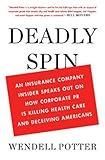
As I wrote in my book, Deadly Spin, PR firms representing the health insurance industry routinely furnished conservative pundits and so-called journalists with talking points their consultants developed to scare people away from reform.

The insurance industry has spent millions of our premium dollars over the years on linguistic research and message testing to assist it in disseminating false and misleading information to manipulate public opinion.

I devoted an entire chapter to the industry's "playbook." Here is one of the tactics I said included in the playbook:

Feed talking points to TV pundits and freaquent contributors to op-ed pages. They will know how to get talk show hosts with big audiences like Rush Limbaugh or Bill O'Reilly or Glenn Beck to say things on the air to support your point of view and discredit your opponents.

This morning grassroots advocacy coalition Health Care for America Now asked its supporters to "reject Fox News and its attempts to continually attack the Affordable Care Act and the people who support it under the guise of legitimate 'reporting.'"

I am calling on Rupert Murdoch to fire Sammon, and I am calling on Fox's so-called journalists and the network's producers, many of whom I know and have worked with over the years, to denounce Sammon's partisan approach to reporting and commentary. I am further calling on them -- and the news staff at the Wall Street Journal, also owned by Murcoch, to dedicate themselves to truly being "fair and balanced" and to familiarize themselves with the profession's code of ethics.

Northing short of our democracy is at stake here, folks.

[Update 4:54PM ET: Added mention of HCAN's action.]

-->

Follow Wendell Potter on Twitter: www.twitter.com/wendellpotter

Jan Brewer Medicaid Cuts Prompt Dire Calls For Life-Saving Coverage & Criticism Of 'Brewercare'

Arizona Governor Jan Brewer is facing intense criticism and scrutiny for declining requests to hold a special session to reinstate medical transplant coverage, which for some patients was covered by the state until recently when the health care program ended.

The Tucson Sentinel reported on Tuesday:

Mesa resident Randy Shepherd, a 36-year-old father of three, has been living with a pacemaker for several years and now is facing what he says is his last treatment option: a heart transplant.

But Shepherd's hopes for a transplant were dashed when the state cut Medicaid funding for certain transplants under the Arizona Health Care Cost Containment System.

"Look at all of us who need these transplants," Shepherd said, joined Tuesday by three others who say they are unable to get live-saving transplants due to the cuts. "It's not an option for us; it's a necessity."

Tiffany Tate, who told the Arizona-based outlet that she was diagnosed with a chronic lung disease when she was a young child more than two decades ago, addressed the stakes she faces if she is unable to receive treatment.

"The state needs to come together so we can have a second chance at life," she explained. "I want to travel, to play basketball again. It would mean everything to me."

ThinkProgress relays video of a CBS interview with Tate that aired on Tuesday night.
Story continues below

The Arizona Republic reports:

Democratic legislators again called for Brewer to hold a special session or use discretionary federal stimulus funds to reinstate cuts for certain transplant coverage through the Arizona Health Care Cost Containment System.

Brewer maintains her position that unless legislators provide a solution to what her office calls a $1 billion gap in funding for the Medicaid agency, she will not call a special session.

The AP recently reported:

"This "Brewercare" has set up real death panels here in Arizona and it is outrageous and disgusting," said [Arizona Democratic state] Rep. Anna Tovar, who had bone marrow transplants in 2001 and 2002 to treat leukemia.

The Medicaid cuts have also reportedly been criticized as "Brewer death panels."

The New York Times recently reported:

Even physicians with decades of experience telling patients that their lives are nearing an end are having difficulty discussing a potentially fatal condition that has arisen in Arizona: Death by budget cut. ... Just before the Oct. 1 deadline, Mark Price, a father of six who was fighting leukemia, learned he needed a bone marrow transplant. But his doctor, Jeffrey R. Schriber, found donor matches for his transplant the very day the new rules went into effect, and Mr. Price no longer qualified for coverage by the Arizona Health Care Cost Containment System, the formal name for the state's Medicaid program.

What happened next was at once inspirational and heart-rending.

Out of the blue, an anonymous financial donor quickly stepped forward and agreed to cover the hundreds of thousands of dollars needed for Mr. Price's surgery. But Mr. Price died last weekend, after his cancer returned before the operation could be done. He was buried on Thursday, next to his grandfather.

According to Arizona Fox affiliate KMSB-TV, Arizona ranks below average on a list of the healthiest and least healthy states in the country. The local outlet reported that the Grand Canyon state came in 31st as suggested by the data put out by the the non-profit United Health Foundation.

On Wednesday, the Arizona Republic reported on a small silver lining to the tragic and dire situation:

As a result of news coverage, patients registered in the National Transplant Assistance Fund have seen a surge of donations. As of Saturday, Laveen liver-disease patient Francisco Felix had raised $74,124 and Mesa heart-transplant hopeful Randy Shepherd had raised $52,720, according to the organization. Both need to raise hundreds of thousands of dollars more.

Wednesday, December 8, 2010

The World's Greatest Jailhouse Lawyer

HOME » Legal
 

The World's Greatest Jailhouse Lawyer

Article Word Count: 683 [View Summary] Comments (0)

The jailhouse lawyer is a familiar figure in fiction, and like the unctuous salesman, or gruff small town sheriff, he is not merely a product of literary imagination. There are jailhouse lawyers of varying degrees of competence doing time and providing legal aid to their fellow inmates in prisons all across America.

The most highly reputed jailhouse lawyer of all was one Jerome ('Jerry the Jew') Rosenberg, who was convicted of murder in the first degree for the killing of two New York City police officers in May of 1962. He was sentenced to death, but was able to get his sentence commuted to life in prison in 1965 by then New York State Governor Nelson Rockefeller. In all, he spent 46 years in three different state prisons, from February of 1963 until his death at 72 on June 1, 2009, earning himself the dubious distinction of having been incarcerated for a longer stretch than any other inmate in the New York State prison system.

Within the first four years of his prison sentence, he earned a degree from the Blackstone School of Law, an accredited correspondence school, thereby becoming the first inmate of a New York State prison to earn a law degree while incarcerated. As prison libraries stocked with legal tomes didn't yet exist in the 1960s, his family helped with his studies by bringing him law books. It wasn't until 1977 that, in reference to Bounds v. Smith, the Supreme Court deemed a prisoner's lack of access to legal research facilities a violation of the Fourteenth Amendment, which says in part, "...nor shall any State deprive any person of life, liberty, or property, without the due process of law; nor deny to any person within its jurisdiction the equal protection of the laws."

Even in later years as Rosenberg gained better access to law books, being a jailhouse lawyer was not easy. These self-styled legal eagles often have to contend with retaliation from prison officials. According to a 1989 study on prison discipline, solitary confinement is a common disciplinary tactic used against jailhouse lawyers. In fact, the largest number of prisoners by far confined to "control units" are jailhouse lawyers.

Despite the many obstacles he faced, Rosenberg was able to help thousands of his fellow prisoners over approximately four decades as a practicing jailhouse lawyer, gaining release from prison or reduced sentences for many of them. In 1981, he actually argued a case in open court, before the honorable Judge Albert Rosenblatt. He was the only prison inmate ever allowed to do so.

Rosenberg played a key, but ultimately futile, role in the Attica prison riot of 1971. He drafted a brief for a court injunction against any administrative or physical reprisals from prison officials if the prisoners agreed to release their hostages and end the rebellion. The injunction was granted, but Rosenberg was not satisfied with its terms and ended up ripping it to shreds. Soon after that, the negotiations broke down completely, New York State troopers stormed the prison, and the riot was put to an end with a hail of gunfire.

Even though the Attica negotiations were not successful, Ronald L. Kuby, the former law partner of an attorney who worked closely with Rosenberg during the Attica prison riot, praised him, saying:

Of all the jailhouse lawyers, he was the greatest and the best known. He came of age in prison before there was widespread access to counsel for post-conviction proceedings.

Rosenberg never succeeded in employing his legal knowledge and skills to win his own freedom. At one point, he even argued for an appeal of his case in front of the very judge who had originally sentenced him. This was the judge's wry comment:

When I send them away, they never come back. Not only did [Rosenberg] come back, he came back as a lawyer.

However, for all his legal acumen and the grudging respect it won him in many quarters, Jerome Rosenberg was no saint. His arrest on the murder charges that he consistently denied was by no means his first brush with the law.

On the other hand, bad luck can befall the best of us. Almost anyone can at some time find themselves at odds with the authorities. If you or a loved one in the Santa Barbara area should be in such a situation, visit http://bailbondssantabarbara.net. to find a reputable and reliable bail bondsman in Santa Barbara to get you out of jail before you ever require the services of a jailhouse lawyer.

Article Source: http://EzineArticles.com/?expert=Eric_Hilton

Close
MLA Style Citation:
Hilton, Eric "The World's Greatest Jailhouse Lawyer." The World's Greatest Jailhouse Lawyer. 24 Nov. 2010 EzineArticles.com. 8 Dec. 2010 <http://ezinearticles.com/?The-­Worlds-­Greatest-­Jailhouse-­Lawyer&id=5431877>.
APA Style Citation:
Hilton, E. (2010, November 24). The World's Greatest Jailhouse Lawyer. Retrieved December 8, 2010, from http://ezinearticles.com/?The-­Worlds-­Greatest-­Jailhouse-­Lawyer&id=5431877
Chicago Style Citation:
Hilton, Eric "The World's Greatest Jailhouse Lawyer." The World's Greatest Jailhouse Lawyer EzineArticles.com. http://ezinearticles.com/?The-­Worlds-­Greatest-­Jailhouse-­Lawyer&id=5431877

Most Recent EzineArticles from the Legal Category:


This article has been viewed 12 time(s).
Article Submitted On: November 24, 2010

Rep. Ed Markey: Time to Move Like the Wind to Save Clean Energy

The framework tax deal announced this week by President Obama and GOP leaders in the Senate threatens to kill jobs in one of the sectors our nation needs most -- clean energy.

In its current form, the deal would allow the only effective federal support mechanism for renewable electricity to expire, killing the 20,000 wind energy jobs and 11,200 jobs in geothermal that would be created in 2011, and the 65,000 jobs in solar over the next two years.

In addition, without an extension of the Renewable Energy Grant Program (1603), the domestic wind industry will lay off upwards of 25 percent of its workforce -- 20,000 people -- on the first of January.

This is not acceptable.

**

In order to create new jobs, we must create brand new industries. Renewable energy -- like wind, solar and geothermal -- is a natural resource that can be harvested domestically with equipment and technology made in America.

Unfortunately, Republicans in Congress don't see it that way. They are determined to keep America tethered to the dirty, pollution-heavy energy industries of the past. This Congress, Republicans have fought to keep some $36 billion in subsidies for the biggest industry in the mix -- oil and gas.

That would be the same oil industry that has dictated a failed U.S. energy policy for decades. It is one that runs on foreign oil, siphoning half a billion dollars a day out of the U.S. economy and directing it to OPEC and nations in the Middle East that support terrorist activity. Foreign oil alone represents nearly half our trade deficit.

This is not acceptable.

**

We need an oil change. That is why Democrats in Congress are fighting to extend the Renewable Energy Grant Program (1603) for two years. This program was created under the Recovery Act as a patch for the production tax credit (PTC) and the investment tax credit (ITC) programs.

In the wake of the Republican recession that destroyed eight million jobs and dismantled financial markets in 2008, new clean-energy entrepreneurs and small businesses could not get access to credit -- meaning the existing production tax credit and the investment tax programs no longer worked.

Democrats acted in an emergency situation to save these jobs and ensure that the American clean-energy sector -- which has the potential to become the most important global economic driver for the next century -- did not meet an untimely end.

And the results are clear. The Renewable Energy Grant Program created 55,000 jobs and directly led to the deployment of 4,250 megawatts of renewable energy in 2009.

**

Harvesting this clean, safe renewable energy has also created an opportunity to breathe new life into America's factories. The Recovery Act also included the Clean Energy Manufacturing Program (48C) allocating $2.3 billion in tax credits for building and expanding manufacturing facilities.

That provided a 30 percent tax credit for investments in 183 manufacturing facilities for clean energy products across 43 states to support 41,000 jobs. Demand for this program exceeded expectations -- $7.7 billion worth of applications poured in -- and it helped get Americans out of unemployment lines and back onto assembly lines building wind turbines and solar panels.

**

Democrats in the House spent the past two years fighting to forge a real, long-term plan for American energy independence, a plan that ensures the United States doesn't take second place to China in the race for clean-energy jobs and technology.

Our plan included a Renewable Electricity Standard, electric vehicle incentives, and efficiency measures. Our plan protected consumers from price spikes, like $4 gas, and gave small business and entrepreneurs the chance to compete with Big Oil.

Unfortunately, other than the Recovery Act, Republicans in the Senate killed every attempt to move forward on clean energy. As a result, the private investment community is now looking to move trillions of dollars away from the U.S. That money may now be spent on jobs in China, South Korea, Europe, and elsewhere.

This is not acceptable.

That is why, at a minimum, THIS Congress and the president must immediately move to protect and extend both the Renewable Energy Grant Program and the Clean Energy Manufacturing Program.

While Republican leaders may hope to push clean energy off the agenda in the 112th Congress, the reality is the threat of foreign oil, rising gas prices and jobs competition from China will keep these problems front and center.

Follow Rep. Ed Markey on Twitter: www.twitter.com/markeymemo

TheYoungTurks's Channel

HuffPost TV: Arianna On Conan: Jeggings, Naked Divorcees, And The Only Kind Of Internet News People Will Pay For (VIDEO)

Sunday, December 5, 2010

Obama Tells Dems He'll Oppose Tax Cut Deal Without Unemployment Benefits, Other Relief

WASHINGTON — At a meeting at the White House with Democratic congressional leadership Saturday afternoon, President Obama said he would oppose any compromise deal on the expiring Bush tax cuts if it lacked help for the unemployed and other provisions designed to aid the middle class.

Speaking with House Speaker Nancy Pelosi (D-Cali.) and Senate Majority Leader Harry Reid (D-Nev.) shortly after the Senate failed to pass his preferred tax cut package proposal, Obama drew sharp lines in the sand with respect to ongoing negotiations.

"The President told Democratic Congressional leaders today that he was open to compromise, but he would oppose even a temporary extension of the Bush tax cuts if it did not include an extension of benefits for the unemployed and extensions of the other tax cuts that benefit middle class families," a White House official told the Huffington Post. "Without them, taxes would still rise for 95 percent of Americans."

The official did not have specifics as to what period of time the president would find acceptable for an extension of unemployment benefits. Nor is it clear if the president would be fine with those benefits being offset while tax cut extension remains unpaid for. Among the "other tax cuts" that the president is demanding is the Make-Work-Pay tax credit and "a bunch of others expire at the end of the year."

The remarks are, nevertheless, one of the clearest signs that the president is not only done ceding any more policy turf to the GOP with respect to tax cut negotiations but willing to let rates expire if Republican don't temper their demands.

Said one person with knowledge of what was discussed: "This was the kind of signal that the Hill has been looking for." The question, the person added, is "when is the president going to make this announcement and how is he going to do it."

Putting aside when or how the announcement is made, the quote from the White House official portends a deal along the lines that Hill aides projected last week. In exchange for a temporary extension of Bush tax cuts, Democrats will secure an extension of unemployment benefits, a few more tax cut proposals, and a vote on the START Treaty.

Saturday, December 4, 2010

Solar Battery Maintainer and Trickle Charger Video Reviews

A review of the Sunsei SE-150 solar battery maintainer.

The California Wine Festival in Santa Barbara | Santa Barbara Wine Tasting

California’s Liquid Gold – The California Wine Festival in Santa Barbara
By Suzanne De Cornelia

Wine Tasting _120

California is the world’s foremost place to make wine, and as attendees of the California Wine Festival this July 16th-18th in Santa Barbara will discover-it is a most romantic place to taste and savor it.

The French attribute the wine’s charm to its terroir. Terroir extends influences beyond soil composition, microclimate, grape quality and vineyard management to include the spirit of place. To me terroir includes the romance of Old California, heart-stopping sunrises and sunsets, the tang of the great Pacific, the astonishing variety and fragrance of California nature, even the quality of our golden light that goes into California wines, too.

California is America’s leading agriculture state. We produce high quality meats, seafood, vegetables, fruits, oils and olives, and artisan breads, herbs, cheeses and wines. Farmer’s Markets are our Meccas. Their intensely fresh, bursting with flavor and colorful organic and sustainable ingredients are why California restaurants place among the top in the world. The expression ‘God is in the Details’ explains why the same rich soils that grew our apples, citrus, berries and flowers, enriches our wine grapes that create a rich and buttery glass of Chardonnay, with its aromas and flavors of citrus, apple and pear, and notes of toast and vanilla to pair with our state’s famous Dungeness crab. We respect these fine nuances and details.

Santa Barbara Public Rose GardenSince the Spanish missionaries planted California’s first vineyards in the late 1700s, winemaking methods have evolved through successive waves of immigrant Italian, German, Portuguese and French winemakers. And today, California’s multi-generational, small family owned enterprises have adopted sustainable practices, with many becoming organic or biodynamic to protect their families, communities, consumers and the environment.

The payoff is tremendous. California is the world’s fourth largest wine producing region, exports 95% of U.S. wines, produces 309,000 jobs and $51.8 billion in economic value for California, and 875,000 jobs and $125.3 billion economic value nationwide. California winemaking attracts nearly 20 million tourists each year.

Robert Mondavi, one of a handful of California’s leading wine pioneers, summed up California’s golden treasure, “Wine to me is passion. It’s family and friends. It’s warmth of heart and generosity of spirit. Wine is art. It’s culture. It’s the essence of civilization and the art of living.”

On July 16-18 come taste California’s wine and spirit in Santa Barbara. Come and drink our liquid gold. http://californiawinefestival.com/

© 2008-2012-Suzanne de Cornelia. All worldwide rights apply. This article may be reprinted on websites as long as the entire article, including website link and resource box are included and unchanged. Suzanne is a freelance writer and Web 2.0 expert. Her novel “French Heart” will be released in Summer 2009. Contact Suzanne on FaceBook, follow her on Twitter @SuzanneDeC. And click-on her site now for a terrific blogroll of free resources: http://suzannedecornelia.com/

No Responses to “ The California Wine Festival in Santa Barbara ”

Sorry, comments for this entry are closed at this time.

The California Wine Festival is held every July in Santa Barbara.

How to Determine a Good Wine | Santa Barbara Wine Tasting

Wine Tasting Santa BarbaraHow to Determine What is a Good Wine?
By Peter BrownsWhen someone says that they like a particular wine because it is good, what do they mean by that? Well, most of the time, a good wine is simply just a wine they enjoy the most. It is as simple as that however; there are some standards that wine experts agree upon to decide whether a wine is good or not. These standards involve concepts such as balance, length, depth, and complexity.

1. Balance: The four major components of wines are sweetness, acidity, tannin and alcohol. Balance is just simply the relationship of these four components to one another. A wine is balance when there is nothing sticks out as you taste it. Balance in a wine is a key indicator of the quality.

2. Length: Is this wine short or long? When someone asks you that question, they did not mean to ask about the size of the bottle. In fact, length in wine refers to how long the wine goes in your tongue when you taste it. If it goes across your tongue when you taste it, it is long wine. If it just goes half way through your tongue, it is short wine. Length is sure a sign of high quality.

3. Depth: The depth concept refers to vertical dimensions when you drink. It is flat when it feels like just one dimension. A depth wine is a great wine.

4. Complexity: A wine is a complexity when it gives you multiplicity of aromas and flavors. When you taste a complex wine, it reveals different things about itself to you. It shows you a new flavor or impression every time you drink it.

To determine whether a wine is good or bad would need time and practice. However, always keep in mind that these concepts about wine are just objective measurements. We all taste things differently.

Enjoy your party with plastic champagne flutes and plastic martini glasses.

Article Source: http://EzineArticles.com/?expert=Peter_Browns
http://EzineArticles.com/?How-to-Determine-What-is-a-Good-Wine?&id=3307008

No Responses to “ How to Determine a Good Wine ”

Sorry, comments for this entry are closed at this time.

Interesting article about how exactly you go about determining what is and what isn't a good wine.

Veteran now faces felony conspiracy charge | Featured Story | Wichita Eagle

Veteran now faces felony conspiracy charge

64 Comments

BY TIM POTTER

The Wichita Eagle

Photos

«
1 of 2
»
  • Prosecutors today charged a decorated, double-amputee veteran with stalking and three counts of criminal use of a firearm in an incident involving members of a controversial Topeka church. Ryan J. Newell, 26, an Army veteran living in Marion, made his first appearance in Sedgwick County District Court through a video connection with the Sedgwick County Jail. He also was charged with false impersonation. His bond remains at $500,000.

  • Travis Heying/The Wichita Eagle | Buy this photo

    This home was build for Ryan Newell in Marion recently. Newell, who lost both legs in combat while in Afghanistan, is being held in the Sedgwick County Jail on 500,000 bond. (Dec. 1, 2010)

In a Wichita case that has captured national attention, a double-amputee war veteran already accused of misdemeanors against a controversial Topeka church now faces a felony charge.

The latest charge — conspiracy to commit aggravated battery — was filed by Sedgwick County prosecutors Friday afternoon. The charge accuses Army veteran Ryan Newell of engaging in a conspiracy in which firearms were obtained and put in his vehicle and taken to a place where church members were located.

Mid-morning Tuesday, detectives arrested Newell. He was backed into a parking spot outside Wichita City Hall with guns and ammunition in his SUV while five Westboro church members met inside with Wichita police officials to discuss protest-safety concerns, sources have said.

The felony charge alleges that there was a conspiracy in which Newell entered into an agreement with another person.

Newell's bond remains at $500,000. His next court appearance is set for Dec. 16.

Judge Ben Burgess said at a hearing Friday that if Newell were to post the bond, there would be a hearing to consider additional conditions for his release. One condition already set is that he have no contact with Westboro members.

The Eagle on Friday received calls from New Hampshire to Nevada from people wanting to give money to Newell's legal defense or bond.

Kim Parker, the chief deputy district attorney in Sedgwick County, noted that the case has received wide attention and "that the public's sympathies may weigh heavy."

Still, Parker said, "We decide cases based on the facts and the law. We don't decide cases based on whether we like or dislike the victim or the suspect."

Meanwhile, two people — the lawyer for Newell and a spokeswoman for Westboro — say Newell is the subject of other investigations.

Newell, 26, of Marion, has remained in the Sedgwick County Jail since Tuesday evening.

"It's obvious that Mr. Newell has a great outpouring of support, some of whom share our client's view of supporting our country," said lawyer Boyd McPherson, who along with fellow Wichita lawyer Steve Joseph is representing Newell.

"He's not interested in publicity," McPherson said of Newell. "He appreciates all the support that's being offered."

Westboro and its members have been widely condemned for protesting at soldiers' funerals nationwide. Westboro contends that soldiers are dying because God is punishing the nation for immorality.

Margie Phelps is one of the five Westboro members who protested Tuesday outside Mulvane High School and then rode in a van to Wichita City Hall, where detectives arrested Newell.

Westboro members have picketed at almost 600 soldiers' funerals in the last 5 1/2 years, Phelps said. The protests generally have taken place a half-mile to a mile from funeral locations, she said. The protesters from Westboro leave when the funerals start, she said.

At nearly all of the protests, veterans on motorcycles and their supporters have been present, she said. "They track us down and try to shut us up and do harm to us," said Phelps, 54.

"Those guys aren't going to shut us up," she said. "That can be written in stone."

On Thursday, prosecutors charged Newell with stalking, three counts of criminal use of weapons and one count of false impersonation of a law enforcement officer.

The stalking charge accuses Newell of actions targeted at Westboro members and putting them in fear for their safety. Sedgwick County sheriff's detectives arrested Newell after a sheriff's detective saw him following a Westboro van to City Hall, officials said.

The weapons charges accuse Newell of unlawfully carrying and concealing or possessing with "intent to use" an M4 rifle, .45-caliber Glock handgun and .38-caliber Smith and Wesson handgun. Besides the weapons, Newell also had more than 90 rounds of ammunition in his vehicle, sources said.

An M4 rifle is a high-powered weapon used in combat; there are variations of the rifle, according to websites.

Westboro spokeswoman Shirley Phelps-Roper said earlier Friday: "Here is what I expect to happen: This guy is going to be called a hero, he may get a parade."

People "will line up to sing his praises, to pay his legal fees and to get him a lawyer," she said. "Then he will be permitted to plead to some nothing charges."

Phelps-Roper also said, "We've had communication about a federal investigation" involving Newell. "And I don't think I ought to say any more about that."

FBI spokeswoman Bridget Patton said she could neither confirm or deny the existence of an investigation.

The Eagle has previously reported that agents with the federal Bureau of Alcohol, Tobacco, Firearms and Explosives went to Newell's home and obtained items including firearms.

McPherson, Newell's lawyer, said, "I'm hearing that there are other investigations that are pending." He declined to elaborate.

McPherson said he is working to make sure that Newell's medical needs are met while he is in jail. McPherson said he thinks Newell has been placed in the jail clinic because of medications associated with his war injuries.

Newell lost his legs in 2008 when an improvised bomb exploded in Afghanistan. Some of his fellow soldiers died in the explosion.

Contributing: Deb Gruver and Hurst Laviana of The Eagle Reach Tim Potter at 316-268-6684 or tpotter@wichitaeagle.com.

Subscribe to our newsletters

72 super PACs spent $83.7 million on election, financial disclosure reports show

The 72 super PACs, all formed this year, together spent $83.7 million on the election. The figures provide the best indication yet of the impact of recent Supreme Court decisions that opened the door for wealthy individuals and corporations to give unlimited contributions.

The financial disclosure reports also underscore the extent to which the flow of corporate money will be tied to political goals. Private-equity partners and hedge fund managers, for example, have a substantial stake in several issues before Congress, primarily the taxes they pay on their earnings.

"Super PACs provide a means for the super wealthy to have even more influence and an even greater voice in the political process," said Meredith McGehee, a lobbyist for the Campaign Legal Center, which advocates for tighter regulation of money in politics.

American Crossroads, a conservative super PAC that outspent its peers, pulled in six- and seven-figure donations from the financial industry. That included $500,000 from Anne Dias-Griffin, founder of the Aragon Global Management hedge fund, and her husband, Kenneth Griffin, founder of the Citadel Investment Group hedge fund.

Crossroads, which was founded with the support of Bush administration adviser Karl Rove, raised $70 million, much of it used to support 10 Republican Senate candidates and 30 Republican House candidates.

John Childs, founder of Boston-based J.W. Childs Associates, gave $650,000 to the Club for Growth, an anti-tax group. Dalea Partners, a private-equity firm based in Oklahoma City, gave $250,000 to the First Amendment Alliance, which spent money opposing five Democratic Senate candidates, including incumbents Harry M. Reid (Nev.) and Michael Bennet (Colo.).

Most of the donations from the financial industry went to interest groups attacking Democrats, the disclosure reports show.

That follows support from some Democrats for a measure that would increase tax rates on income executives receive as "carried interest." The proposals would raise the tax above its current 15 percent rate. Other income for those in the highest bracket is taxed at a 35 percent rate.

Several measures that would change the tax rate for carried interest have passed the House in recent years but have stalled in the Senate each time. Democrats have proposed raising the tax as a source of revenue to pay for other programs; that is now unlikely given the Republican takeover of the House after the November elections.

Private-equity partners and hedge fund managers argue that carried interest should be taxed at the same rate as investment income because there is risk involved.

Under federal law, donations to candidates and the political parties cannot exceed certain limits. But recent court decisions have removed limits for contributions to interest groups operating independently of candidates.

The Supreme Court's ruling this year in Citizens United v. Federal Election Commission found that corporations, unions and nonprofit groups could spend unlimited money on advertising directly attacking or supporting candidates. In a separate decision, a federal court in the District removed limits on contributions to those groups.

To take advantage of the loosened regulations, political activists created super PACs, which are allowed to accept any kind of contribution as long as they disclose their donors and do not coordinate with candidates.

Super PACs represent only one portion of the spending spurred by the court's decision. Nonprofit groups that are not required to disclose their donors also spent heavily on the election.

Hedge funds and private-equity partners have previously tended to favor Democratic candidates with their contributions. For example, George Soros, founder of the Soros Fund Management hedge fund, has in the past donated large amounts to Democratic interest groups.

The new figures show that this year, other financial industry executives have supported liberal groups. The group Accountability 2010, which spent money attacking Republican House candidate Steve Pearce in New Mexico, drew contributions from half a dozen financial industry executives. They included $45,000 from George Denny, co-founder of the private-equity firm Halpern, Denny & Co., according to the reports, which were filed with the FEC on Thursday night.

Staff writer Dan Eggen contributed to this report.